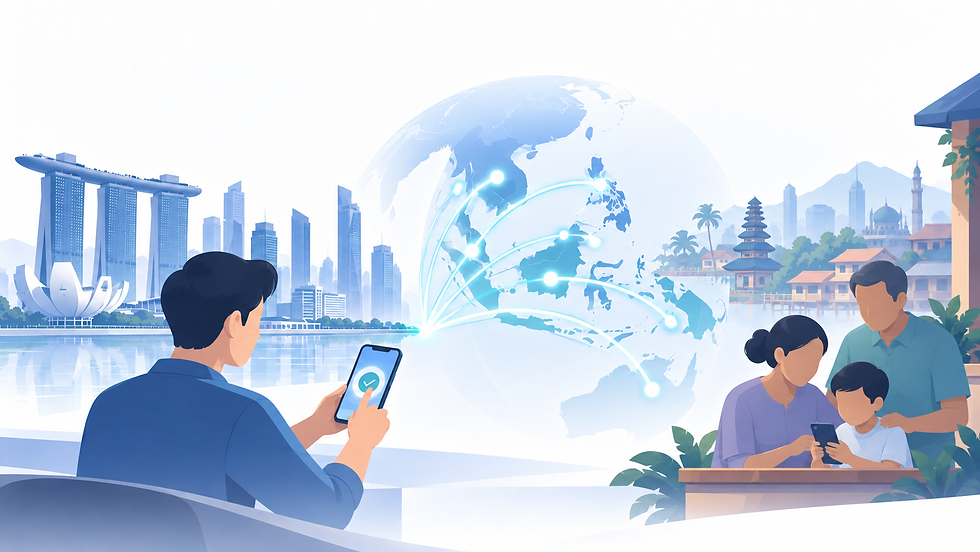
Why Millions of People Still Send Money Across Borders Every Month
Behind Every International Payment Is a Reason — and Someone Waiting on the Other Side
A Report by CYS Global Remit Digital Media Marketing Team
Somewhere today, a parent will receive money from a son or daughter working thousands of kilometers away. A student's education will be paid for from another country. A family will use money sent from overseas to cover groceries, rent or household expenses. A supplier will release an order because an international payment has arrived.
Different people. Different countries. Different circumstances. But they all share one invisible connection: Money crossing borders because people's lives do too.
In a world where money can be spent with a tap, invested with a click and managed from a mobile phone, it is easy to think of an international payment as simply another digital transaction. But behind every amount sent, there is usually a purpose. And very often, there is someone depending on it.
More Than Money Moving from One Country to Another
For millions of people working overseas, sending money home is part of everyday life.
A portion of each month's salary may go towards supporting ageing parents, paying for a child's education, covering household expenses or helping family members through a difficult period. Others may be saving towards something bigger—a home, a business or a more secure future.
To the payment system, these may appear simply as transactions. To the people receiving them, they can mean something entirely different. A month's groceries. A school fee paid on time. Rent covered. A medical or household expense taken care of. A little less financial worry for someone back home.
That is what makes remittance different from simply moving numbers between accounts. The money has somewhere to go, but more importantly, it has something to do when it gets there.
Our Lives No Longer Fit Neatly Within Borders
The world has become increasingly international. People leave home to pursue careers elsewhere. Students travel overseas for education. Families may live in several countries. Entrepreneurs find suppliers thousands of kilometers away. Businesses sell to customers they may never meet in person. A parent in Singapore may be supporting a child studying abroad. A professional working here may send part of a salary home each month. A business owner may need to pay manufacturers, suppliers or partners in several different markets.
Technology has made distance feel smaller. Video calls allow families to see one another instantly. Messages cross the world in seconds. Businesses can communicate with suppliers on another continent almost as easily as with someone across town.
But financial responsibilities do not disappear simply because people live far apart. In many cases, they become even more important. Distance may separate people. Responsibility still connects them.
For Businesses, Payments Keep Things Moving
The human story behind remittance is important, but cross-border payments are not only about individuals sending money home. Businesses depend on them too.
Consider a Singapore SME importing goods from an overseas manufacturer. The supplier may require payment before releasing the shipment. Until that payment arrives, the goods may not move. And if the goods don't move, inventory doesn't arrive. Orders may be delayed. Customers may have to wait. Cash flow may be affected.
A transaction that appears to be a simple supplier payment can therefore influence an entire chain of business activity. The same applies to companies expanding internationally. They may need to pay overseas employees, settle operating expenses, manage foreign-currency obligations or transfer funds between different markets.
In all these situations, the payment itself is only one part of a much bigger story. International payments don't simply move money. They help keep businesses moving.
What People Expect Has Changed
The reasons for sending money internationally may be familiar. The expectations surrounding the experience are not. Today, customers increasingly want to know more about what happens between pressing “send” and the money reaching its destination.
What exchange rate am I receiving? What will the transaction cost? How long should the payment take? Can I see what is happening to it? What happens if something goes wrong? These are reasonable questions.
People have become accustomed to greater transparency and control in almost every part of their digital lives. Naturally, they increasingly expect the same from financial services. Businesses expect even more.
Companies operating internationally may need to manage multiple currencies, payment destinations, suppliers and settlement schedules. They are therefore looking beyond whether a provider can simply execute an international transfer.
The question is no longer only: “Can I send money overseas?” Increasingly, it is: “Can I send it in a way that works for me?”
Reliability Is Personal
Speed matters in cross-border payments. Cost matters. Exchange rates matter. Convenience matters. But reliability matters too.
Because a delayed payment isn't simply a delayed transaction. It might be a supplier waiting before releasing goods.
A student waiting for funds. A family budgeting for monthly expenses. Or a business waiting for money before it can fulfil its next obligation.
What looks like a routine transfer from one side of the transaction may be very important on the other. That is why customers need more than the ability to send money.
They need confidence that the payment process is secure, transparent and dependable. Because when somebody is waiting at the other end, reliability isn't just an operational matter. It becomes personal.
Technology Makes Payments Faster. Purpose Makes Them Meaningful
Cross-border payments have changed enormously. Processes that once required paperwork, physical counters and lengthy waiting periods can increasingly be completed digitally. Technology will continue making international payments faster, simpler and more convenient.
And that is a good thing. But technology does not change the fundamental reason cross-border payments exist. People do. People move. Families spread across countries. Students pursue opportunities overseas. Businesses find new suppliers and customers. Companies expand into new markets.
And as people and businesses become more internationally connected, money must move alongside them. That is the human connection behind cross-border payments.
Behind Every Payment Is a Story
At CYS Global Remit, moving money across borders has been part of what we do for decades. Every day, we see amounts, currencies, exchange rates, beneficiaries and destinations.
But those numbers never tell the whole story. Behind an amount is a purpose. Behind a beneficiary is a person or a business. Behind a payment is often a commitment someone intends to fulfil. A family being supported. A student being given an opportunity. A supplier being paid. A business continuing to operate. An investment in something that may happen tomorrow.
Perhaps that is why, despite all the changes in technology, millions of people continue to send money across borders every month.
Not because moving money itself is remarkable. But because of what that money makes possible once it arrives. And that is something worth remembering every time we call it simply a "transaction." Because while money may move across borders, the reasons behind it are always close to home.